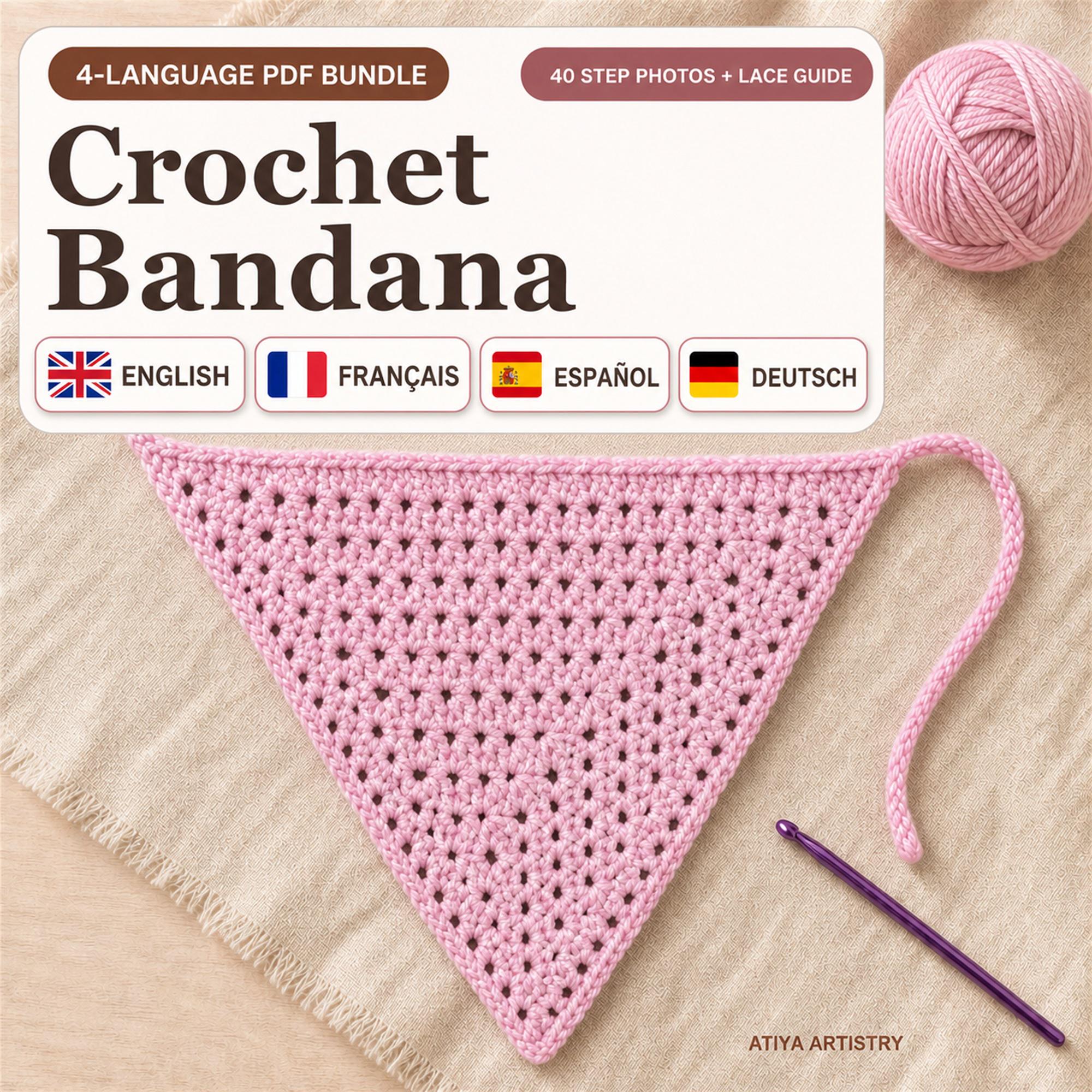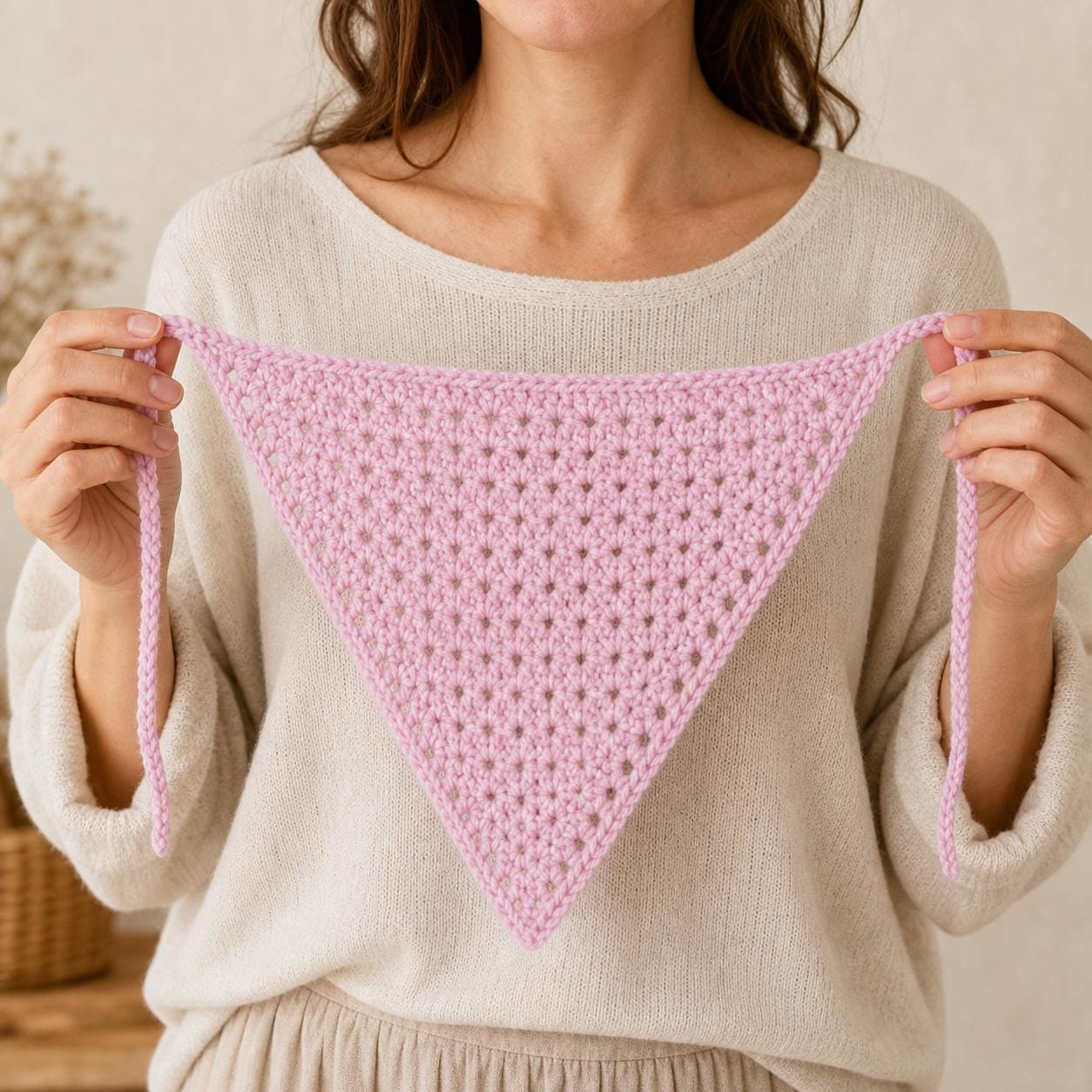
A comfortable crochet bandana should be wide enough to cover the intended part of the head, deep enough to sit securely, and finished with ties that hold without pulling. Lightweight cotton or a breathable cotton blend is usually a practical yarn choice.
A crochet bandana pattern is a rewarding project for beginners because it combines simple shaping with a wearable result. Bandanas may be built as triangles, joined motifs, granny-style pieces, lace panels, or rows that increase gradually from a narrow point. The finished accessory can be styled as a headscarf, hair covering, neck kerchief, or decorative summer layer.
The most common problems are not difficult stitches. They are sizing, yarn choice, tie length, and edge finishing. This guide explains how to make those decisions before starting a complete pattern so the finished bandana feels comfortable and looks balanced.
WHAT IS A CROCHET BANDANA?
A crochet bandana is a small triangular or shaped scarf designed to sit over the hair or around the neck. It differs from a full shawl because it is more compact and usually includes ties or narrow ends for securing it.
Common styles include:
- Classic triangle bandana
- Granny stitch headscarf
- Floral motif bandana
- Lacy summer kerchief
- Solid stitch hair scarf
- Bandana with long wraparound ties
Some patterns are worked from the top edge toward the point. Others begin at the point and increase outward. Motif designs may be assembled from individual squares or flowers.
WHY CROCHET BANDANAS ARE BEGINNER-FRIENDLY
A bandana is smaller than a shawl and usually requires less yarn. It teaches important skills without becoming an overwhelming project.
- Reading row-by-row instructions
- Increasing evenly
- Maintaining straight edges
- Working chain spaces or granny clusters
- Adding a border
- Creating ties
- Blocking a wearable accessory
A beginner should choose a pattern with exact finished measurements and clear guidance on adjusting the size. “One size” can still fit differently depending on head circumference, hair volume, yarn, hook, and tension.
BEST YARN FOR A CROCHET BANDANA
The yarn rests close to the face, scalp, and neck, so comfort matters. A smooth cotton or cotton blend is breathable and shows stitch definition. Bamboo blends can create soft drape. Acrylic is affordable and available in many colors, though the feel and breathability vary.
Cotton
- Main advantage: Breathable and crisp
- Possible drawback: Can feel heavier when thick
- Best season: Spring and summer
Cotton blend
- Main advantage: Soft with useful structure
- Possible drawback: Properties vary by blend
- Best season: Most seasons
Bamboo blend
- Main advantage: Soft, cool, and drapey
- Possible drawback: May stretch
- Best season: Warm weather
Acrylic
- Main advantage: Affordable and colorful
- Possible drawback: Can feel warmer
- Best season: Cool weather or decorative use
Wool blend
- Main advantage: Warm and textured
- Possible drawback: May irritate sensitive skin
- Best season: Autumn and winter
Lightweight yarn usually creates a more comfortable headscarf than bulky yarn. A smooth strand also makes it easier to see stitch placement, especially in lace or openwork sections.
HOW MUCH YARN DOES A BANDANA NEED?
Yardage depends on the size, yarn weight, stitch pattern, border, and tie length. An open granny-style design may use less yarn than a dense solid fabric of the same dimensions. Long wraparound ties can add more yardage than expected.
Use the amount stated in the pattern and keep a little extra for swatching, size adjustments, and secure finishing. When color consistency matters, purchase enough yarn from one dye lot.
HOW TO CHOOSE A HOOK SIZE
The hook controls both fabric density and drape. A bandana needs enough flexibility to follow the shape of the head. A hook that is too small may create a stiff triangle that lifts away from the hair. A hook that is too large may create loose gaps and unstable ties.
Make a small swatch in the main stitch pattern. Hold it against the side of your head or bend it gently. It should curve without resisting, but the stitches should still look controlled.
Stiff and board-like
- What it may mean: Hook too small or tension too tight
- Adjustment: Try a larger hook
Very loose and unstable
- What it may mean: Hook too large
- Adjustment: Try a smaller hook
Correct width but heavy drape
- What it may mean: Yarn may be too thick
- Adjustment: Consider the pattern yarn weight
Edges pull inward
- What it may mean: Turning chains or edge stitches too tight
- Adjustment: Relax edge tension
HOW TO MEASURE FOR A CROCHET BANDANA
Measure the head where the bandana will sit. For many styles, this is around the hairline and the back of the head. Then decide how much coverage you want.
Head circumference
- How to take it: Measure around the intended wearing position
- Why it matters: Helps determine width and tie length
Top width
- How to take it: Measure across the area to be covered
- Why it matters: Controls side coverage
Triangle depth
- How to take it: Measure from top edge toward the back
- Why it matters: Controls how much hair is covered
Desired tie length
- How to take it: Measure from the bandana edge to the knot position
- Why it matters: Determines secure and comfortable fastening
Hair volume changes fit. A bandana worn over thick curls, braids, or a bun may need more width than one worn over flat hair. Compare the pattern measurements with a fabric scarf that already fits well.
UNDERSTANDING TRIANGLE CONSTRUCTION
A triangle can grow from the center top, from one side, or from the bottom point. The increase placement creates the shape.
Point-up
- How it grows: Begins at the bottom point and widens
- Useful feature: Easy to stop when the desired width is reached
Top-down center
- How it grows: Begins at the top and increases at center and edges
- Useful feature: Creates a symmetrical triangular shape
Side-to-side
- How it grows: Increases to the widest point, then decreases
- Useful feature: Useful for stripes and directional texture
Motif assembly
- How it grows: Squares or flowers are joined into a triangle
- Useful feature: Creates decorative color and texture
Read the pattern notes to learn whether turning chains count as stitches. This small detail affects edge shape and stitch counts throughout the project.
HOW TO ADJUST BANDANA SIZE
Many triangular patterns can be enlarged by repeating the established increase row. However, not every design can be adjusted freely. A motif pattern may require complete repeats, and a decorative border may need a specific stitch multiple.
Before adding rows:
- Check whether the pattern states a repeat multiple.
- Measure the top edge rather than relying only on row count.
- Remember that blocking may increase the final dimensions.
- Account for ties separately from the main body.
- Test the bandana against the head before finishing the border.
To make a smaller size, stop earlier only when the stitch pattern and border will still fit correctly. A well-written pattern explains the safest adjustment point.
HOW LONG SHOULD BANDANA TIES BE?
Ties should be long enough to form a secure knot without creating excessive bulk. Short ties may be difficult to fasten, while very long ties can stretch or hang awkwardly.
Consider how the bandana will be worn:
- A simple back knot needs moderate tie length.
- A bow requires more length.
- Wraparound styling needs significantly longer ties.
- A neck kerchief may use different proportions than a hair scarf.
Before fastening off, hold the bandana in position and test the tie length. Yarn can stretch after repeated wear, so avoid making the ties longer than necessary.
CREATING COMFORTABLE EDGES
The top edge rests against the head and should not feel rough or tight. A border can strengthen the edge, hide row ends, and create a finished appearance. Common borders include single crochet, reverse single crochet, picots, shells, or simple chain spaces.
Work evenly across row ends. Too many border stitches create rippling. Too few pull the bandana into a curve. If the pattern gives a placement ratio, follow it carefully.
HOW TO KEEP TRIANGLE EDGES STRAIGHT
Uneven edges often come from missing the first stitch, adding a stitch at the turning chain, or changing tension at the end of rows. Use markers at both outer edges when learning a new repeat.
- Count every row during the increase section.
- Identify whether the turning chain counts as a stitch.
- Place the final stitch in the same type of location each row.
- Keep turning chains relaxed but not oversized.
- Lay the piece flat regularly to inspect symmetry.
A border can improve a slightly uneven edge, but it cannot fully correct major differences in row length.
BLOCKING A CROCHET BANDANA
Blocking is especially valuable for lace, granny stitch, and motif bandanas. It opens the stitch pattern, straightens the top edge, and defines the triangle.
1. Check the yarn care label.
2. Wet or steam block using a fiber-safe method.
3. Lay the bandana on a clean blocking surface.
4. Pin the top edge straight.
5. Shape the center point and side edges evenly.
6. Arrange the ties without stretching them excessively.
7. Allow the piece to dry completely.
Measure during blocking. Pulling too far can make the lace attractive on the mat but too loose when worn.
STYLING A CROCHET BANDANA
A single bandana can be worn in several ways:
- Over loose hair with the point at the back
- Under a low bun
- Across the hairline as a kerchief
- With the ties wrapped around a ponytail
- Loosely around the neck
- As a decorative layer over braids
For everyday wear, secure the knot without pulling tightly against the scalp. If the fabric slides, the issue may be yarn smoothness, bandana width, or tie position rather than the tightness of the knot.
COLOR AND STYLE IDEAS
Boho summer
- Suggested colors: Cream, rust, mustard, sage
- Suitable stitch style: Granny or open lace
Cottagecore floral
- Suggested colors: Pink, green, ivory
- Suitable stitch style: Flower motifs or scalloped border
Modern minimal
- Suggested colors: Black, stone, beige
- Suitable stitch style: Simple solid triangle
Festival bright
- Suggested colors: Orange, turquoise, magenta
- Suitable stitch style: Openwork with long ties
Soft romantic
- Suggested colors: Blush, lavender, cream
- Suitable stitch style: Fine lace or floral texture
When using several colors, plan where the ends will be woven in. Too many small color changes can create bulk along the edge or point.
COMMON CROCHET BANDANA MISTAKES
IGNORING FINISHED MEASUREMENTS
Row count alone does not guarantee fit because tension and yarn can change the dimensions.
USING A STIFF YARN
The bandana may look attractive when flat but fail to curve comfortably around the head.
ADDING TOO MANY BORDER STITCHES
This creates waves along the edge. Distribute border stitches evenly.
MAKING TIES TOO NARROW FOR THE YARN
Thin ties can curl or stretch. Use the pattern construction and reinforce them when appropriate.
SKIPPING A FIT CHECK
Try the bandana on before the final border and before trimming yarn tails.
BLOCKING THE TIES UNDER TOO MUCH TENSION
This can lengthen them more than expected and weaken the shape of the ends.
CARE AND STORAGE
Follow the care instructions for the yarn. Hand washing is often a gentle choice for shaped accessories, especially when lace or long ties are included. Reshape the bandana and dry it flat.
Store it folded rather than hanging by the ties. Hanging can stretch narrow sections over time. Keep light-colored cotton away from damp or dusty storage areas.
IS A CROCHET BANDANA A GOOD FIRST WEARABLE?
Yes. It is smaller and faster than a garment, but it still teaches fit, drape, finishing, and personal adjustment. A beginner should choose a pattern with simple repeats, progress photos, and clear size information.
Look for:
- A stated skill level
- Yarn weight and yardage
- Hook recommendation
- Finished width and depth
- Instructions for changing size
- Clear tie construction
- Blocking guidance
Ready to begin? Explore digital crochet patterns and wearable accessories from Atiya Artistry at the Atiya Artistry Etsy shop .
FREQUENTLY ASKED QUESTIONS
WHAT YARN IS BEST FOR A CROCHET BANDANA?
Lightweight cotton or a breathable cotton blend is a practical choice because it is comfortable, shows stitches clearly, and works well in warm weather.
HOW MUCH YARN IS NEEDED FOR A CROCHET BANDANA?
The amount depends on yarn weight, size, stitch pattern, and tie length. Many bandanas use less yarn than a full scarf, but always follow the pattern yardage.
HOW DO I MAKE A CROCHET BANDANA BIGGER?
Repeat the established increase rows only when the design allows it. Check stitch multiples and border requirements before changing the size.
WHY DOES MY CROCHET BANDANA CURL?
Curling may result from tight tension, an undersized hook, uneven border placement, or unblocked fabric.
CAN BEGINNERS CROCHET A BANDANA?
Yes. Choose a pattern using basic stitches, clear increases, exact measurements, and a simple border.
HOW DO I STOP A CROCHET BANDANA FROM SLIPPING?
Check that the main triangle has enough width, position the ties lower behind the ears, and avoid an excessively smooth or heavy yarn. Do not solve slipping by tying it painfully tight.
FINAL THOUGHTS
A crochet bandana is a small project, but fit and yarn choice determine whether it becomes a favorite accessory. Measure before starting, choose a breathable fiber, test the drape, and check the fit before finishing the ties. Blocking will refine the shape and make decorative stitches more visible.
Find wearable crochet patterns and instant digital downloads at Atiya Artistry on Etsy .