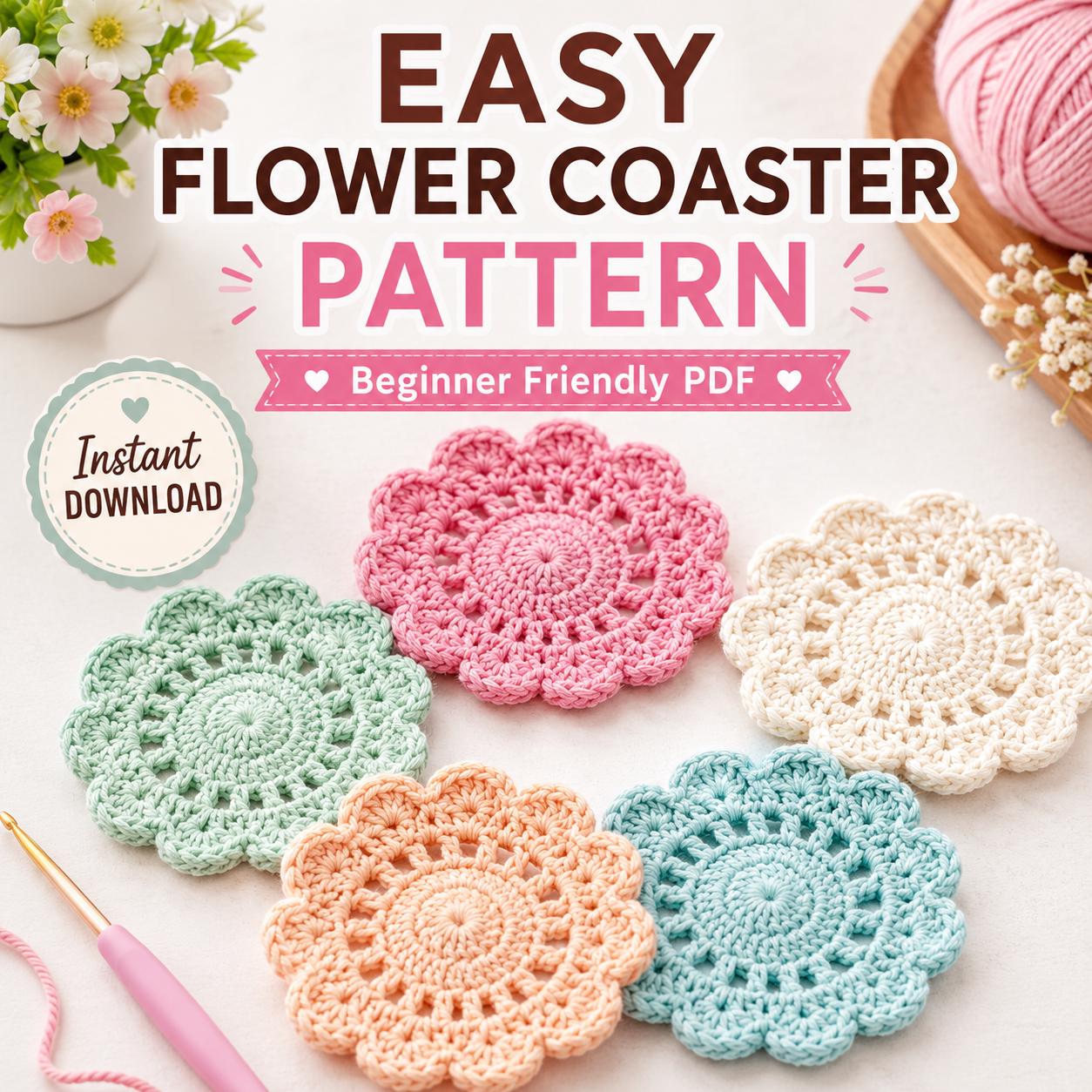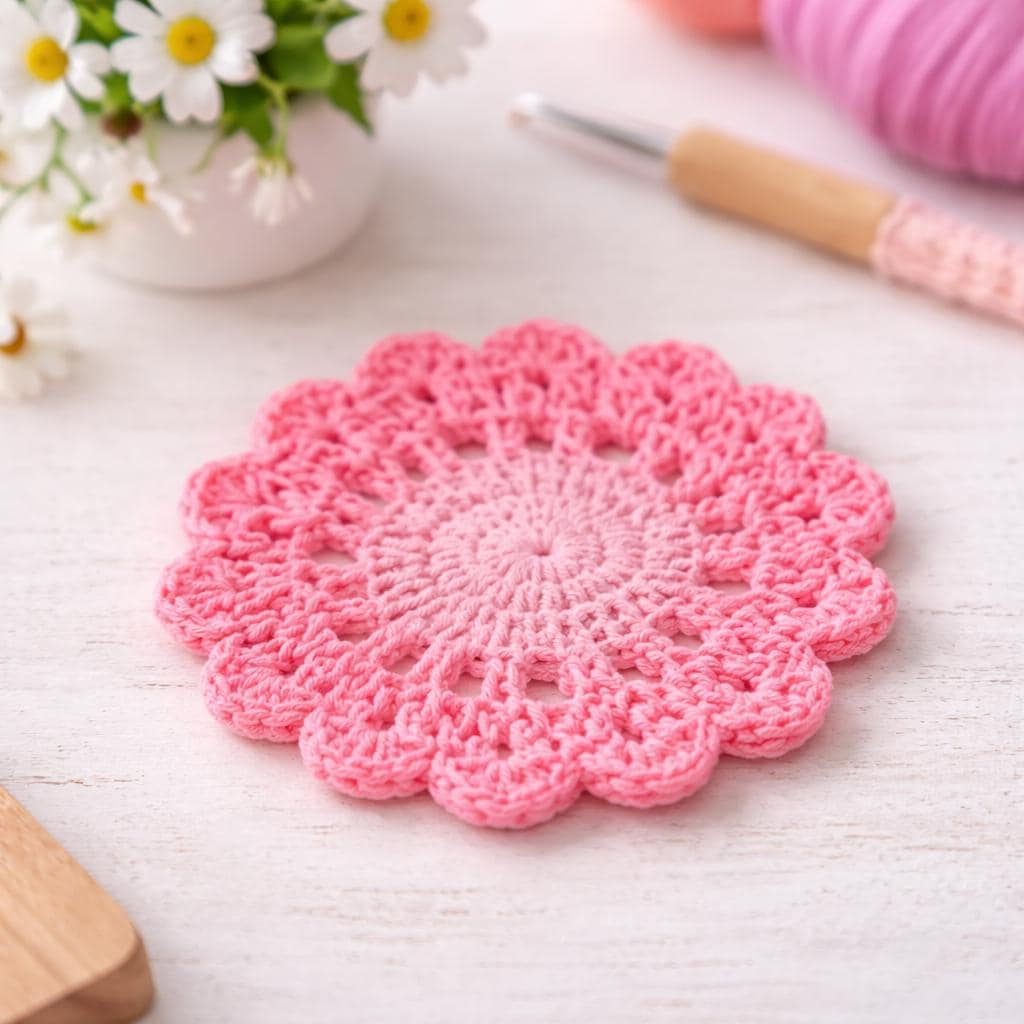
The best flower crochet coasters are made with absorbent cotton yarn, an appropriately sized hook, even tension, and a flat center. Petals should be shaped consistently, and the finished coaster should be blocked so it rests smoothly under a cup.
A flower crochet coaster pattern is an ideal small project for beginners because it teaches working in rounds, counting stitches, changing colors, shaping decorative edges, and finishing neatly. It also produces something useful in a short amount of time. A single coaster can become a cheerful desk accessory, while a coordinated set makes a thoughtful housewarming, birthday, or holiday gift.
This guide explains the choices that matter most before you begin: yarn fiber, hook size, finished dimensions, color combinations, petal construction, blocking, care, and troubleshooting. It does not replace the exact stitch counts in a complete PDF pattern, but it will help you understand why each part of the project works.
WHAT MAKES A GOOD CROCHET COASTER?
A coaster has a simple job: it should sit flat, protect the surface below it, and remain stable when a cup is placed on top. Decorative petals can add beauty, but the center must still be practical.
A reliable crochet coaster should have:
- A flat center without rippling or cupping
- Enough density to catch condensation
- A finished size that supports common cups and mugs
- Secure color changes and woven-in ends
- Petals that do not fold into the drinking area
- A washable yarn suitable for repeated use
Flower coasters often look more advanced than plain circles, but many are built from basic stitches repeated around the edge. The visual effect comes from spacing, increases, and clusters rather than difficult techniques.
BEST YARN FOR FLOWER CROCHET COASTERS
Cotton is usually the strongest choice for functional coasters. It absorbs moisture, handles warmth well, shows stitch definition, and can often be washed easily. Acrylic yarn is widely available and colorful, but it absorbs less moisture and should not be treated as a heat-resistant material for very hot cookware.
100% cotton
- Absorbency: High
- Stitch definition: Clear
- Recommended use: Everyday drink coasters
Cotton blend
- Absorbency: Moderate to high
- Stitch definition: Usually clear
- Recommended use: Softer decorative sets
Acrylic
- Absorbency: Low
- Stitch definition: Varies
- Recommended use: Decorative or practice pieces
Wool
- Absorbency: Moderate
- Stitch definition: Soft
- Recommended use: Specialty sets that require gentle care
A smooth DK, sport, or light worsted cotton is often easy to handle. Very thick yarn can make the coaster bulky, while very thin thread requires more rounds and finer tension control. Follow the yarn weight recommended by the pattern when you want the photographed result.
HOW MUCH YARN DOES ONE COASTER NEED?
Flower coasters are useful stash-busting projects because each piece requires a relatively small amount of yarn. The exact yardage depends on diameter, yarn weight, stitch height, and the number of petals. A two-color design may use one color for the center and another for the outer flower.
When making a matching set, prepare enough yarn from the same dye lot. Small color differences that are barely visible in a ball can become noticeable when finished coasters are placed together.
CHOOSING A CROCHET HOOK
The hook should create a fabric that is firm but not rigid. If the hook is too large, the coaster may have wide gaps and weak edges. If it is too small, the fabric can become stiff and the stitches may be difficult to work.
Make the first coaster as a test piece. Measure it after finishing and check whether it lies flat. Then decide whether to change the hook size before making the rest of the set.
Loose fabric with large gaps
- Likely cause: Hook too large or tension too loose
- Possible adjustment: Use a smaller hook or tighten tension slightly
Very stiff fabric
- Likely cause: Hook too small or tension too tight
- Possible adjustment: Use a larger hook
Edges ripple
- Likely cause: Too many stitches or loose outer rounds
- Possible adjustment: Check stitch count and pattern placement
Center forms a bowl
- Likely cause: Too few increases or tight tension
- Possible adjustment: Recount and relax tension
HOW A FLOWER COASTER IS USUALLY CONSTRUCTED
Most flower coasters begin at the center and are worked outward in joined or continuous rounds. The central rounds create the practical surface. The final rounds create petal shapes through combinations of chains, taller stitches, clusters, shells, or skipped stitches.
The general process is:
1. Create a magic ring or starting chain loop.
2. Work the first round into the center.
3. Increase evenly to keep the circle flat.
4. Change color if the design uses a contrasting flower edge.
5. Create evenly spaced petal foundations.
6. Work each petal using the pattern’s stitch sequence.
7. Join the round cleanly and fasten off.
8. Weave in ends and block the finished coaster.
Exact counts matter because a repeated petal section must fit evenly around the circle. One missing or extra stitch can shift every petal that follows.
HOW TO KEEP A CROCHET CIRCLE FLAT
A flat center depends on a balanced increase rate. Too few increases pull the fabric upward into a cup. Too many increases create waves around the edge. Tension can also affect the shape, especially when one round is worked much more tightly than the previous round.
Use these checks after every round:
- Place the piece on a flat surface.
- Confirm the stitch count before starting the next round.
- Check that increases are evenly distributed.
- Make sure the joining slip stitch is not unusually tight.
- Do not pull chain stitches smaller than the surrounding fabric.
A slight curve may disappear after the next round or during blocking, but strong rippling usually becomes worse if the stitch count is not corrected.
COLOR IDEAS FOR FLOWER COASTERS
Color selection changes the personality of the same pattern. Soft neutrals create a calm, modern set. Bright centers and petals create a playful spring or summer look. Earthy shades suit farmhouse and autumn decor.
Classic daisy
- Center color: Yellow or gold
- Petal color: White or cream
- Overall effect: Fresh and cheerful
Romantic floral
- Center color: Dusty rose
- Petal color: Blush or ivory
- Overall effect: Soft and elegant
Modern neutral
- Center color: Warm beige
- Petal color: Cream or taupe
- Overall effect: Minimal and versatile
Summer bright
- Center color: Orange
- Petal color: Pink, coral, or yellow
- Overall effect: Bold and playful
Autumn flower
- Center color: Brown or mustard
- Petal color: Rust, olive, or burgundy
- Overall effect: Warm and seasonal
For a gift set, choose two or three coordinating shades rather than using a completely different palette for every coaster. Repetition makes the set feel intentional.
CHANGING COLORS NEATLY
For a clean color transition, complete the final yarn-over of the last stitch with the new color. This prepares the next stitch without creating an obvious knot. Keep the unused tail long enough to weave securely into the back.
When the center and petals use different colors, inspect the back before trimming anything. Loose ends can create bumps that prevent the coaster from resting flat. Weave each tail through several stitches in more than one direction.
HOW TO CREATE EVEN PETALS
Petals look consistent when the foundation spaces, stitch heights, and tension are repeated accurately. Place a removable marker in the first petal so it is easy to identify the end of the round. After each petal, compare its height and width with the previous one.
- Keep chain loops the same size.
- Insert the hook into the exact space named in the pattern.
- Do not pull the final slip stitch too tightly.
- Count the number of petals before fastening off.
- Shape petals with your fingers before blocking.
If one petal is visibly different, correct it before moving on. A small tension issue is easier to fix immediately than after the full edge is complete.
COMMON FLOWER COASTER MISTAKES
MISCOUNTING THE FIRST ROUND
The first round controls every later increase. Count carefully before closing it.
CONFUSING THE JOINING STITCH WITH A REGULAR STITCH
A slip stitch used to join a round is often not counted as a normal stitch. Follow the pattern notes and mark the first true stitch.
WORKING PETALS WITH DIFFERENT TENSION
If one petal is tight and the next is loose, the flower looks uneven. Pause after each petal and compare its height and width with the previous one.
USING NON-ABSORBENT YARN FOR A FUNCTIONAL COASTER
The finished item may look attractive but fail to catch condensation. Use cotton when practical performance matters.
SKIPPING BLOCKING
Blocking can turn a slightly uneven flower into a polished, symmetrical coaster. It is one of the fastest ways to improve the final presentation.
HOW TO BLOCK A CROCHET FLOWER COASTER
Check the yarn label before adding water or heat. For wet blocking, gently soak or dampen the coaster, remove excess water without twisting, shape it on a blocking mat, and pin the petals evenly. Allow it to dry completely.
Measure from the center to the tip of each petal while pinning. Equal spacing makes the flower look professional. Do not stretch the coaster so far that the center becomes thin or the petals lose their natural curve.
CARE AND WASHING
Coasters eventually collect coffee marks, moisture, and dust. Cotton sets are often washable, but the safest care method is always the one recommended for the yarn.
- Wash gently in cool or lukewarm water.
- Avoid harsh twisting.
- Reshape the petals while damp.
- Dry flat to preserve the circular center.
- Store only when completely dry.
WAYS TO USE CROCHET FLOWER COASTERS
Beyond everyday cups, flower coasters can be used as small plant-pot mats, decorative table accents, gift-box toppers, party favors, or additions to handmade care packages. A coordinated set tied with ribbon creates a present that is useful, lightweight, and easy to mail.
They can also support seasonal displays. Pastel sets work for spring, red and green for winter holidays, warm earth tones for autumn, and bright tropical colors for summer gatherings. The pattern remains the same while the palette changes the theme.
HOW TO PRESENT A COASTER SET AS A GIFT
Stack the finished coasters evenly after blocking. Tie the set with cotton ribbon, twine, or a paper band. Include a small care card stating the fiber content and washing instructions. If the recipient may use them under hot mugs, clearly explain that they are drink coasters rather than trivets for cookware.
Housewarming
- Suggested palette: Neutral or kitchen-matching colors
- Packaging idea: Paper band with care instructions
Birthday
- Suggested palette: Recipient’s favorite colors
- Packaging idea: Ribbon and handwritten tag
Mother’s Day
- Suggested palette: Blush, cream, lavender
- Packaging idea: Small gift box
Holiday
- Suggested palette: Red, green, cream, gold
- Packaging idea: Twine with seasonal label
Teacher gift
- Suggested palette: Bright cheerful colors
- Packaging idea: Pair with a reusable mug
CAN BEGINNERS MAKE FLOWER COASTERS?
Yes. A flower coaster is a strong beginner project after learning chains, slip stitches, single crochet, and one or two taller stitches. The small size makes it possible to practise without committing to a large amount of yarn.
Look for a pattern with:
- Standard terminology clearly stated
- A full abbreviation list
- Stitch totals for each round
- Close-up progress photos
- Finished diameter
- Yarn and hook recommendations
- Blocking guidance
Looking for a guided design? Browse Atiya Artistry’s digital crochet patterns, including flower coaster designs, at the Atiya Artistry Etsy shop .
FREQUENTLY ASKED QUESTIONS
WHAT YARN IS BEST FOR CROCHET COASTERS?
Absorbent cotton yarn is usually the best choice for drink coasters. It creates clear stitches, handles repeated use, and is generally easier to wash than delicate fibers.
WHY IS MY CROCHET COASTER CURLING?
Curling can result from tight tension, too few increases, or a hook that is too small. Recheck the stitch count and compare your gauge with the pattern.
WHY IS MY CROCHET COASTER WAVY?
Waves usually mean there are too many stitches, the increases are too frequent, or the outer rounds are being worked more loosely.
HOW LARGE SHOULD A CROCHET COASTER BE?
Many drink coasters are approximately 4 to 5 inches across, but the correct size depends on the design and intended cup. Use the finished measurement in the pattern.
ARE FLOWER CROCHET COASTERS BEGINNER-FRIENDLY?
Yes. A clear pattern can teach beginners how to work in rounds, count stitches, change colors, and create repeated petal shapes.
CAN I SELL FINISHED COASTERS MADE FROM A PATTERN?
Check the specific designer’s terms. Many designers allow small-scale sales of finished items with credit, but the pattern PDF itself may not be copied, shared, translated, or resold.
FINAL THOUGHTS
A flower coaster is small enough to finish quickly but detailed enough to build real crochet skills. Start with a smooth cotton yarn, count every round, maintain steady tension, and block the petals carefully. Those habits create a coaster that looks decorative while still performing its practical purpose.
Find beginner-friendly PDF patterns and more handmade inspiration at Atiya Artistry on Etsy .